
A Brief History of the Café Table
Joie de vivre, by the inch: The surprisingly storied life of the little French table that could.
What a café table lacks in diameter, it handily makes up for in provenance. Thirty to 36 inches can hold a lot of brilliance: Ernest Hemingway reportedly wrote novel after novel at the bistro tables of Saint-Germain-des-Prés; Jean-Paul Sartre and Simone de Beauvoir debated existentialism at them for hours. Even Picasso sketched at café tables as he helped usher in modernism.
Decades later, the singular magic of the café table endures, perhaps because so few pieces of furniture ask so little of a terrace, garden, or city sidewalk, while giving so much in return. Just large enough for two, café tables hold only the most important things: an espresso, or perhaps a glass of rosé catching the late-afternoon light like a jewel. A still-warm croissant. A journal and pen, and the day’s paper. Its pair of chairs can pull close—not across the cacophonous expanse of a lengthy dining table, but near, so the conversation requires very little projection. The rest of the world circles around you.
And its story began, naturally, in France. In the 17th century, the café table's ancestor, the guéridon, was born, with its shallow round top poised above a column or pedestal. An occasional piece, the guéridon was made to hold a candle, vase, eau-de-vie, or whatever else a civilized life demanded close at hand. (Marie Joséphine of Savoy, Countess of Provence, kept an oak guéridon fitted with a drawer, now at the Château de Versailles.)
The silhouette of the guéridon proved remarkably well suited to outdoor dining. A central pedestal occupies little space and leaves knees unencumbered, allowing chairs to gather easily around the surface. (Strip away the gilding and grandeur inherent in the original guéridons, and the shape begins to look familiar: the elegant economy of the modern round café table.)


By 1686, the Sicilian Francesco Procopio dei Coltelli had established Café Procope in Paris, generally regarded as the city’s first true café. Its mirrors, chandeliers, and intimate tables helped establish the visual vocabulary of European café life. More consequentially, however, Procope gave people somewhere to sit. Voltaire, Rousseau, Diderot, and other Enlightenment thinkers were soon among the habitués of Parisian cafés; Benjamin Franklin also frequented Procope during his years in France, when he was helping secure the alliance that would prove so important to the then fledgling United States. Read more about Café Procope and our favorite spots in Paris here.
The café offered something aristocratic salons could not: a comparatively public place in which ideas might pass between people who had not been formally invited into the same drawing room. Here was a new kind of freedom, and almost anyone could take a seat. And unlike the sprawling refectory tables of many grand châteaux, these bijou tables were essentially democratic. There was no head of the table, quite literally.

By the 19th century, café life increasingly spilled onto the pavement. Parisian boulevards and terraces filled with small tables where patrons could read, argue, flirt, smoke, drink, and ogle everybody else doing exactly the same. The concept cross-pollinated quickly in cafes across Europe (pictured above is our co-founder and CEO, Will Massie, at Caffè Florian in Piazza San Marco in 2000). The café became one of the great settings of modern life precisely because it was neither entirely private nor entirely public. For the price of a drink, one could temporarily claim a few square feet of Paris. Or Venice. Or Vienna. The café table had officially become outdoor furniture, and its materials adapted accordingly. Metal bases offered strength in a relatively slender form; stone and marble tops tolerated the vicissitudes of life.
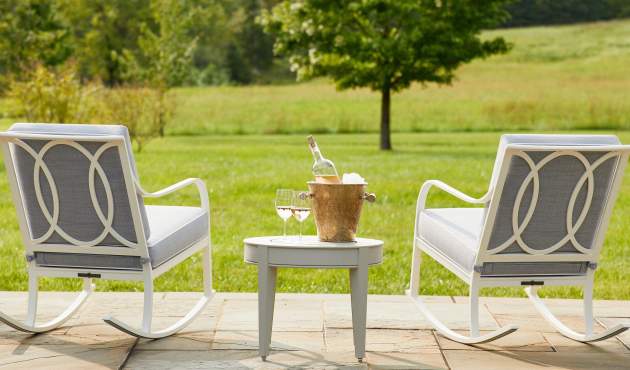
It is a quality that still makes an outdoor café table irresistible. A small table creates a destination without demanding an occasion. Set one beneath a tree, beside a pool, or at the end of a garden path and two chairs will inevitably find their way toward it. So centuries after the guéridon was born, the same logic remains visible in the five pedestal café tables handcrafted by McKinnon and Harris, including the graceful Feolin, banded Toler and substantial, faintly maritime-inspired Maury. The proportions of each one are relatively petite, but the engineering is anything but.

There is something riveting about McKinnon and Harris’s café tables’ journey: an object born pre-French Revolution, sent across an ocean as a symbol of friendship and liberty, eventually coming to rest in a Virginia house and on estates all across the world. The lineage is not literal; it is more interesting than that. The guéridon answered the needs of a French salon; the marble café table suited Procope.; soon iron and stone tables colonized the Paris pavement. McKinnon and Harris is reimagining the form for another chapter: in the garden, terrace, and far into the landscape, where furniture must withstand not simply a season but generations of weather. We've now introduced the Bastille Dining Arm Chair, which nods in name and design to the key of the Bastille, sent by the Marquis de Lafayette to President George Washington after the fortress fell in 1789. The key remains in the collection of Mount Vernon today, and was a fitting muse for our Virginia company making furniture with a whiff of French spirit.
Our five McKinnon and Harris café tables—including the Feolin, Toler, and Maury designs—are handcrafted in high-performance aluminum, bringing formidable structural integrity even as it retains its airy silhouette and intimacy. That may be the café table’s loveliest contradiction. It does not need to look important to be important. For centuries, after all, some of the world’s biggest ideas have fit quite comfortably around a very small table.
Our Café Tables
Paris Café Images: Ekaterina Belova/Adobe Stock